Námsgögn
Innskrá
Hleð efnisyfirliti...
Leita í bók...
Efnafræði 2e (IS)
  • Formáli
    • Inngangur
    • 1.1 Efnafræði í samhengi
    • 1.2 Hamir og flokkun efnis
    • 1.3 Eðlis- og efnafræðilegir eiginleikar
    • 1.4 Mælingar
    • 1.5 Óvissa, réttleiki og nákvæmni mælinga
    • 1.6 Stærðfræðileg meðhöndlun mæliniðurstaðna
    • Lykilhugtök
    • Lykiljöfnur
    • Samantekt
    • Æfingar
    • Inngangur
    • 2.1 Fyrstu hugmyndir atómkenningarinnar
    • 2.2 Þróun atómkenningarinnar
    • 2.3 Atómbygging og táknmál
    • 2.4 Efnaformúlur
    • 2.5 Lotukerfið
    • 2.6 Jóna- og sameindasambönd
    • 2.7 Nafnakerfi efna
    • Lykilhugtök
    • Lykiljöfnur
    • Samantekt
    • Æfingar
    • Inngangur
    • 3.1 Formúlumassi og mólhugtakið
    • 3.2 Ákvörðun reynslu- og sameindaformúla
    • 3.3 Mólstyrkur
    • 3.4 Aðrar einingar fyrir styrk lausna
    • Lykilhugtök
    • Lykiljöfnur
    • Samantekt
    • Æfingar
    • Inngangur
    • 4.1 Ritun og stilling efnajafna
    • 4.2 Flokkun efnahvarfa
    • 4.3 Efnamagnfræði efnahvarfa
    • 4.4 Heimtur efnahvarfa
    • 4.5 Megindleg efnagreining
    • Lykilhugtök
    • Lykiljöfnur
    • Samantekt
    • Æfingar
    • Inngangur
    • 5.1 Grunnatriði orku
    • 5.2 Varmamælingar
    • 5.3 Vermi
    • Lykilhugtök
    • Lykiljöfnur
    • Samantekt
    • Æfingar
    • Inngangur
    • 6.1 Rafsegulorka
    • 6.2 Bohr-líkanið
    • 6.3 Þróun skammtafræðinnar
    • 6.4 Rafeindaskipan atóma (Rafeindahýsingar)
    • 6.5 Lotubundnar breytingar á eiginleikum frumefna
    • Lykilhugtök
    • Lykiljöfnur
    • Samantekt
    • Æfingar
    • Inngangur
    • 7.1 Jónatengi
    • 7.2 Samgild tengi
    • 7.3 Lewis-tákn og byggingar
    • 7.4 Formlegar hleðslur og rafeindaómun
    • 7.5 Styrkur jóna- og samgildra tengja
    • 7.6 Sameindabygging og skautun
    • Lykilhugtök
    • Lykiljöfnur
    • Samantekt
    • Æfingar
    • Inngangur
    • 8.1 Gildistengjakenningin
    • 8.2 Blandaðar atómsvigrúm
    • 8.3 Fjöltengi
    • 8.4 Sameindasvigrúmakenningin
    • Lykilhugtök
    • Lykiljöfnur
    • Samantekt
    • Æfingar
    • Inngangur
    • 9.1 Gasþrýstingur
    • 9.2 Tengsl þrýstings, rúmmáls, magns og hitastigs: Kjörgaslögmálið
    • 9.3 Hvarffræði gastegunda, blandna og efnahvarfa
    • 9.4 Útflæði og sveim gastegunda
    • 9.5 Hreyfifræðikenning sameinda
    • 9.6 Frávik frá kjörgashegðun
    • Lykilhugtök
    • Lykiljöfnur
    • Samantekt
    • Æfingar
    • Inngangur
    • 10.1 Millisameindakraftar
    • 10.2 Eiginleikar vökva
    • 10.3 Fasaskipti
    • 10.4 Fasarit
    • 10.5 Fast ástand efnis
    • 10.6 Grindarbyggingar í kristölluðum föstum efnum
    • Lykilhugtök
    • Lykiljöfnur
    • Samantekt
    • Æfingar
    • Inngangur
    • 11.1 Upplausnarferlið
    • 11.2 Raflausnir
    • 11.3 Leysni
    • 11.4 Samræmdir eiginleikar
    • 11.5 Kvoður
    • Lykilhugtök
    • Lykiljöfnur
    • Samantekt
    • Æfingar
    • Inngangur
    • 12.1 Hraði efnahvarfa
    • 12.2 Þættir sem hafa áhrif á hvarfahraða
    • 12.3 Hraðalögmál
    • 12.4 Heildarhraðalögmál
    • 12.5 Árekstrakenningin
    • 12.6 Hvarfgangar
    • 12.7 Hvatning
    • Lykilhugtök
    • Lykiljöfnur
    • Samantekt
    • Æfingar
    • Inngangur
    • 13.1 Efnajafnvægi
    • 13.2 Jafnvægisfastar
    • 13.3 Hliðrun jafnvægis: Lögmál Le Châteliers
    • 13.4 Jafnvægisútreikningar
    • Lykilhugtök
    • Lykiljöfnur
    • Samantekt
    • Æfingar
    • Inngangur
    • 14.1 Brønsted-Lowry sýrur og basar
    • 14.2 pH og pOH
    • 14.3 Hlutfallslegur styrkur sýra og basa
    • 14.4 Vatnsrof salta
    • 14.5 Fjölróteindasýrur
    • 14.6 Stuðpúðar
    • 14.7 Sýru-basa títranir
    • Lykilhugtök
    • Lykiljöfnur
    • Samantekt
    • Æfingar
    • Inngangur
    • 15.1 Útfelling og upplausn
    • 15.2 Lewis sýrur og basar
    • 15.3 Tengd jafnvægi
    • Lykilhugtök
    • Lykiljöfnur
    • Samantekt
    • Æfingar
    • Inngangur
    • 16.1 Sjálfkrafa ferli
    • 16.2 Óreiða
    • 16.3 Annað og þriðja lögmál varmafræðinnar
    • 16.4 Frjáls orka
    • Lykilhugtök
    • Lykiljöfnur
    • Samantekt
    • Æfingar
    • Inngangur
    • 17.1 Upprifjun á oxunar-afoxunarhvörfum
    • 17.2 Rafhlöður
    • 17.3 Rafskauts- og rafhlöðuspennur
    • 17.4 Spenna, frjáls orka og jafnvægi
    • 17.5 Rafhlöður og efnarafalar
    • 17.6 Tæring
    • 17.7 Rafgreining
    • Lykilhugtök
    • Lykiljöfnur
    • Samantekt
    • Æfingar
    • Inngangur
    • 18.1 Lotubundnir eiginleikar
    • 18.2 Tilvist og framleiðsla dæmigerðra málma
    • 18.3 Bygging og almennir eiginleikar hálfmálma
    • 18.4 Bygging og almennir eiginleikar málmleysingja
    • 18.5 Tilvist, framleiðsla og efnasambönd vetnis
    • 18.6 Tilvist, framleiðsla og eiginleikar karbónata
    • 18.7 Tilvist, framleiðsla og eiginleikar niturs
    • 18.8 Tilvist, framleiðsla og eiginleikar fosfórs
    • 18.9 Tilvist, framleiðsla og efnasambönd súrefnis
    • 18.10 Tilvist, framleiðsla og eiginleikar brennisteins
    • 18.11 Tilvist, framleiðsla og eiginleikar halógena
    • 18.12 Tilvist, framleiðsla og eiginleikar eðalgastegunda
    • Lykilhugtök
    • Samantekt
    • Æfingar
    • Inngangur
    • 19.1 Tilvist, framleiðsla og eiginleikar hliðarmálma og efnasambanda þeirra
    • 19.2 Fléttuefnafræði hliðarmálma
    • 19.3 Litrófs- og seguleiginleikar fléttuefnasambanda
    • Lykilhugtök
    • Samantekt
    • Æfingar
    • Inngangur
    • 20.1 Kolvetni
    • 20.2 Alkóhól og eterar
    • 20.3 Aldehýð, ketón, karboxýlsýrur og esterar
    • 20.4 Amín og amíð
    • Lykilhugtök
    • Samantekt
    • Æfingar
    • Inngangur
    • 21.1 Bygging og stöðugleiki kjarna
    • 21.2 Kjarnajöfnur
    • 21.3 Geislavirk hrörnun
    • 21.4 Umbreyting og kjarnorka
    • 21.5 Notkun geislasamsætna
    • 21.6 Líffræðileg áhrif geislunar
    • Lykilhugtök
    • Lykiljöfnur
    • Samantekt
    • Æfingar
  • A | Lotukerfið
  • B | Nauðsynleg stærðfræði
  • C | Einingar og umreiknistuðlar
  • D | Grunnfastar í eðlisfræði
  • E | Eiginleikar vatns
  • F | Samsetning sýra og basa á markaði
  • G | Staðalvarmafræðilegir eiginleikar valinna efna
  • H | Jónunarfastar daufra sýra
  • I | Jónunarfastar daufra basa
  • J | Leysnimargfeldi
  • K | Myndunarfastar fléttujóna
  • L | Staðalrafskautsmætti (hálfrafhlöðumætti)
  • M | Helmingunartímar nokkurra geislasamsætna
    • Kafli 1
    • Kafli 2
    • Kafli 3
    • Kafli 4
    • Kafli 5
    • Kafli 6
    • Kafli 7
    • Kafli 8
    • Kafli 9
    • Kafli 10
    • Kafli 11
    • Kafli 12
    • Kafli 13
    • Kafli 14
    • Kafli 15
    • Kafli 16
    • Kafli 17
    • Kafli 18
    • Kafli 19
    • Kafli 20
    • Kafli 21
  • Atriðaskrá
  • Efnafræði 2e (IS)SvaralykillKafli 19
    Svaralykill

    Kafli 19

    FYRRI KAFLI

    Kafli 18

    NÆSTI KAFLI

    Kafli 20

    1.

    (a) Sc: [Ar]4s² 3d¹; (b) Ti: [Ar]4s² 3d²; (c) Cr: [Ar]4s¹ 3d⁵; (d) Fe: [Ar]4s² 3d⁶; (e) Ru: [Kr]5s² 4d⁶

    3.

    (a) La: [Xe]6s² 5d¹, La³⁺: [Xe]; (b) Sm: [Xe]6s² 4f⁶, Sm³⁺: [Xe]4f⁵; (c) Lu: [Xe]6s² 4f¹⁴ 5d¹, Lu³⁺: [Xe]4f¹⁴

    5.

    Al er notað vegna þess að það er sterkasti afoxarinn og eini valkosturinn á listanum sem getur veitt nægilegan drifkraft til að breyta La(III) í La.

    7.

    Mo

    9.

    CaSiO₃-gjallið hefur minni eðlismassa en bráðna járnið og því er auðvelt að aðskilja það. Fljótandi gjalllagið myndar einnig hindrun sem kemur í veg fyrir að bráðna járnið komist í snertingu við O₂, sem myndi oxa Fe aftur í Fe₂O₃.

    11.

    2,57%

    13.

    0,167 V

    15.

    E° = −0,6 V. E° er neikvætt, þannig að þessi afoxun er ekki sjálfgeng. E° = +1,1 V.

    17.

    (a) Fe(s) + 2H₃O⁺(aq) + SO₄²⁻(aq) ⟶ Fe²⁺(aq) + SO₄²⁻(aq) + H₂(g) + 2H₂O(l); (b) FeCl₃(aq) + 3Na⁺(aq) + 3OH⁻(aq) ⟶ Fe(OH)₃(s) + 3Na⁺(aq) + 3Cl⁻(aq); (c) Mn(OH)₂(s) + 2H₃O⁺(aq) + 2Br⁻(aq) ⟶ Mn²⁺(aq) + 2Br⁻(aq) + 4H₂O(l); (d) 4Cr(s) + 3O₂(g) ⟶ 2Cr₂O₃(s); (e) Mn₂O₃(s) + 6H₃O⁺(aq) + 6Cl⁻(aq) ⟶ 2MnCl₃(s) + 9H₂O(l); (f) Ti(s) + 2F₂(g) ⟶ TiF₄(g)

    19.

    (a) Cr₂(SO₄)₃(aq) + 2Zn(s) + 2H₃O⁺(aq) ⟶ 2Zn²⁺(aq) + H₂(g) + 2H₂O(l) + 2Cr²⁺(aq) + 3SO₄²⁻(aq); (b) 4TiCl₃(s) + CrO₄²⁻(aq) + 8H⁺(aq) ⟶ 4Ti⁴⁺(aq) + Cr(s) + 4H₂O(l) + 12Cl⁻(aq); (c) Í súrri lausn milli pH 2 og pH 6 myndar CrO₄²⁻ HCrO₄⁻, sem er í jafnvægi við díkrómatjón. Hvarfið er 2HCrO₄⁻(aq) ⟶ Cr₂O₇²⁻(aq) + H₂O(l). Við önnur súr pH-gildi er hvarfið 3Cr²⁺(aq) + CrO₄²⁻(aq) + 8H₃O⁺(aq) ⟶ 4Cr³⁺(aq) + 12H₂O(l); (d) 8CrO₃(s) + 9Mn(s) ⟶ Δ 4Cr₂O₃(s) + 3Mn₃O₄(s); (e) CrO(s) + 2H₃O⁺(aq) + 2NO₃⁻(aq) ⟶ Cr²⁺(aq) + 2NO₃⁻(aq) + 3H₂O(l); (f) CrCl₃(s) + 3NaOH(aq) ⟶ Cr(OH)₃(s) + 3Na⁺(aq) + 3Cl⁻(aq)

    21.

    (a) 3Fe(s) + 4H₂O(g) ⟶ Fe₃O₄(s) + 4H₂(g); (b) 3NaOH(aq) + Fe(NO₃)₃(aq) ⟶ Fe(OH)₃(s) + 3Na⁺(aq) + 3NO₃⁻(aq); (c) MnO₄⁻ + 5Fe²⁺ + 8H⁺ ⟶ Mn²⁺ + 5Fe³⁺ + 4H₂O; (d) Fe(s) + 2H₃O⁺(aq) + SO₄²⁻(aq) ⟶ Fe²⁺(aq) + SO₄²⁻(aq) + H₂(g) + 2H₂O(l); (e) 4Fe²⁺(aq) + O₂(g) + 4HNO₃(aq) ⟶ 4Fe³⁺(aq) + 2H₂O(l) + 4NO₃⁻(aq); (f) FeCO₃(s) + 2HClO₄(aq) ⟶ Fe(ClO₄)₂(aq) + H₂O(l) + CO₂(g); (g) 3Fe(s) + 2O₂(g) ⟶ Δ Fe₃O₄(s)

    23.

    Þegar CN⁻ er bætt við: Ag⁺(aq) + CN⁻(aq) ⟶ AgCN(s). Þegar meira af CN⁻ er bætt við: Ag⁺(aq) + 2CN⁻(aq) ⟶ [Ag(CN)₂]⁻(aq); AgCN(s) + CN⁻(aq) ⟶ [Ag(CN)₂]⁻(aq).

    25.

    (a) Sc³⁺; (b) Ti⁴⁺; (c) V⁵⁺; (d) Cr⁶⁺; (e) Mn⁴⁺; (f) Fe²⁺ og Fe³⁺; (g) Co²⁺ og Co³⁺; (h) Ni²⁺; (i) Cu⁺

    27.

    (a) 4, [Zn(OH)₄]²⁻; (b) 6, [Pd(CN)₆]²⁻; (c) 2, [AuCl₂]⁻; (d) 4, [Pt(NH₃)₂Cl₂]; (e) 6, K[Cr(NH₃)₂Cl₄]; (f) 6, [Co(NH₃)₆][Cr(CN)₆]; (g) 6, [Co(en)₂Br₂]NO₃

    29.

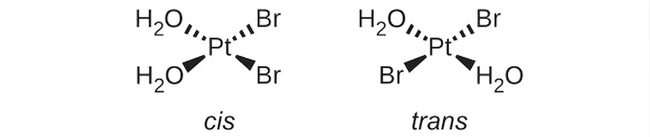
    (a) [Pt(H₂O)₂Br₂]:

    Two structures are shown. At the center of each is a P t atom. The structure on the left is labeled, “cis.” From this atom, a single bond represented by a dashed wedge extends from a vertex at the P t atom up and to the right to a B r atom. Similarly, a single bond represented by a solid wedge extends from a vertex at the P t atom down and to the right to a second B r atom. Another single bond represented by a dashed wedge extends from a vertex at the P t atom up and to the left to the O atom of an H subscript 2 O group. Similarly, a single bond represented by a solid wedge extends from a vertex at the P t atom down and to the left to a second O atom of an H subscript 2 O group. The structure on the right is labeled, “trans.” From the central P t atom, a single bond represented by a dashed wedge extends from a vertex at the P t atom up and to the right to a B r atom. Similarly, a single bond represented by a solid wedge extends from a vertex at the P t atom down and to the right to the O atom of an H subscript 2 O group. Another single bond represented by a dashed wedge extends from a vertex at the P t atom up and to the left to the O atom of a second H subscript 2 O group. Similarly, a single bond represented by a solid wedge extends from a vertex at the P t atom down and to the left to a second B r atom.;

    (b) [Pt(NH₃)(py)(Cl)(Br)]:

    Three structures are shown. At the center of each is a P t atom. From this atom in the first structure on the left, a single bond represented by a dashed wedge extends from a vertex at the P t atom up and to the right to a C l atom. Similarly, a single bond represented by a solid wedge extends from a vertex at the P t atom down and to the right to the N atom of an N H subscript 3 group. Another single bond represented by a dashed wedge extends from a vertex at the P t atom up and to the left to a B r atom. Similarly, a single bond represented by a solid wedge extends from a vertex at the P t atom down and to the left to p y. The middle structure shows a single bond represented by a dashed wedge extending from a vertex at the P t atom up and to the right to a B r atom. Similarly, a single bond represented by a solid wedge extends from a vertex at the P t atom down and to the right to the N atom of an N H subscript 3 group. Another single bond represented by a dashed wedge extends from a vertex at the P t atom up and to the left to p y. Similarly, a single bond represented by a solid wedge extends from a vertex at the P t atom down and to the left to a to a C l atom. The third structure shows a single bond represented by a dashed wedge extending from a vertex at the P t atom up and to the right to p y. Similarly, a single bond represented by a solid wedge extends from a vertex at the P t atom down and to the right to the N atom of an N H subscript 3 group. Another single bond represented by a dashed wedge extends from a vertex at the P t atom up and to the left to a C l atom. Similarly, a single bond represented by a solid wedge extends from a vertex at the P t atom down and to the left to a B r atom.;

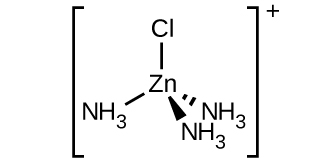
    (c) [Zn(NH₃)₃Cl]⁺:

    Inside of brackets, a central Z n atom is bonded to a C l atom and three N atoms in N H subscript 3 groups in a tetrahedral spatial arrangement. Short line segments are used to represent a bond extending above to the C l atom and down and to the left to the N of the N H subscript 3 group from the Z n atom. A dashed wedge with the vertex at the Z n atom and wide end at the N atom of an N H subscript 3 group is used to represent a bond down and to the right of the Z n atom. The final bond is indicated by a similar solid wedge again directed down and only slightly right of center beneath the Z n atom to the N of an N H subscript 3 group. Outside the brackets a superscript plus sign is shown.;

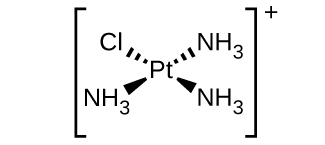
    (d) [Pt(NH₃)₃Cl]⁺:

    This structure shows a single bond represented by a dashed wedge extending from a vertex at the P t atom up and to the right to the N atom of an N H subscript 3 group. Similarly, two single bonds represented by solid wedges extend from vertices at the P t atom down and to the right and down and to the left to the N atoms of N H subscript 3 groups. Another single bond represented by a dashed wedge extends from a vertex at the P t atom up and to the left to a C l atom. This structure is enclosed in brackets with superscript plus sign appearing to the right of the brackets.;

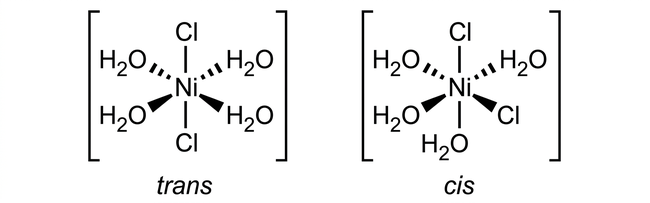
    (e) [Ni(H₂O)₄Cl₂]:

    Two structures are shown. The first is labeled, “trans.” Below this label inside brackets is a central N i atom. From the N i atom, line segments indicate bonds to C l atoms above and below. Above and to both the right and left, dashed wedges with their vertex at the N i atom widening as they move out from the atom indicate bonds with O atoms of H subscript 2 O groups. Similarly, solid wedges below to both the right and left indicate bonds to the O atoms of H subscript 2 O groups. This structure is enclosed in brackets. The second structure is labeled, “cis.” Inside brackets is a central N i atom. From the N i atom, line segments indicate bonds to a C l atom above and the O atom of an H subscript 2 O group below. Above and to both the right and left, dashed wedges indicate bonds with O atoms of H subscript 2 O groups. Similarly, a solid wedge below to the right indicates a bond with a C l atom and a solid wedge to the lower left indicates a bond to the O atoms of an H subscript 2 O group. This structure is also enclosed in brackets.;

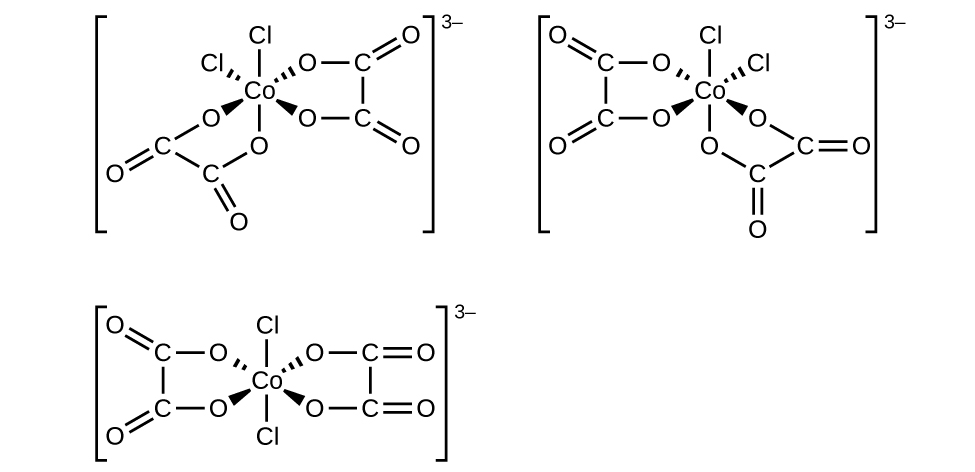
    (f) [Co(C₂O₄)₂Cl₂]³⁻:

    This figure includes three structures. The first structure includes a central C o atom that has four O atoms and two C l atoms attached with single bonds. These bonds are indicated with line segments extending above and below, dashed wedges extending up and to the left and right, and solid wedges extending below and to the left and right. C l atoms are bonded at the top and at the upper left of the structure. The remaining four bonds extend from the central C o atom to O atoms. The O atoms are each connected to C atoms which are each connected with double bonds to O atoms extending outward from the central C o atom. These C atoms are connected in pairs with bonds indicated by short line segments, forming two rings in the structure. This entire structure is enclosed in brackets. Outside the brackets to the right is a superscript 3 negative sign. The second structure, which appears to the be mirror image of the first structure, includes a central C o atom that has four O atoms and two C l atoms attached with single bonds. These bonds are indicated with line segments extending above and below, dashed wedges extending up and to the left and right, and solid wedges extending below and to the left and right. C l atoms are bonded at the top and at the upper right of the structure. The remaining four bonds extend from the central C o atom to O atoms. The O atoms are each connected to C atoms which are each connected with double bonds to O atoms extending outward from the central C o atom. These C atoms are connected in pairs with bonds indicated by short line segments, forming two rings in the structure. This entire structure is enclosed in brackets. Outside the brackets to the right is the superscript 3 negative sign. The third structure includes a central C o atom that has four O atoms and two C l atoms attached with single bonds. These bonds are indicated with line segments extending above and below, dashed wedges extending up and to the left and right, and solid wedges extending below and to the left and right. C l atoms are bonded at the top and bottom of the structure. The remaining four bonds extend from the central C o atom to the O atoms. The O atoms are each connected to C atoms which are in turn each double bonded to O atoms extending outward from the central C o atom. These C atoms are connected in pairs with bonds indicated by short line segments, forming two rings in the structure. This entire structure is enclosed in brackets. Outside the brackets, to the right, is a superscript 3 negative sign. This final structure has rings of atoms on opposite sides of the structure.
    31.

    (a) þríkarbónatokóbaltat(III) jón; (b) tetraammínkopar(II) jón; (c) tetraammíndíbrómókóbalt(III)súlfat; (d) tetraammínplatínu(II)tetraklóróplatinat(II); (e) tris(etýlendíamín)króm(III)nítrat; (f) díammíndíbrómópalladíum(II); (g) kalíumpentaklórókúprat(II); (h) díammíndíklórósink(II)

    33.

    (a) engir; (b) engir; (c) Cl-bindlarnir tveir geta verið cis eða trans. Þegar þeir eru cis er einnig til spegilhverfa.
    35.
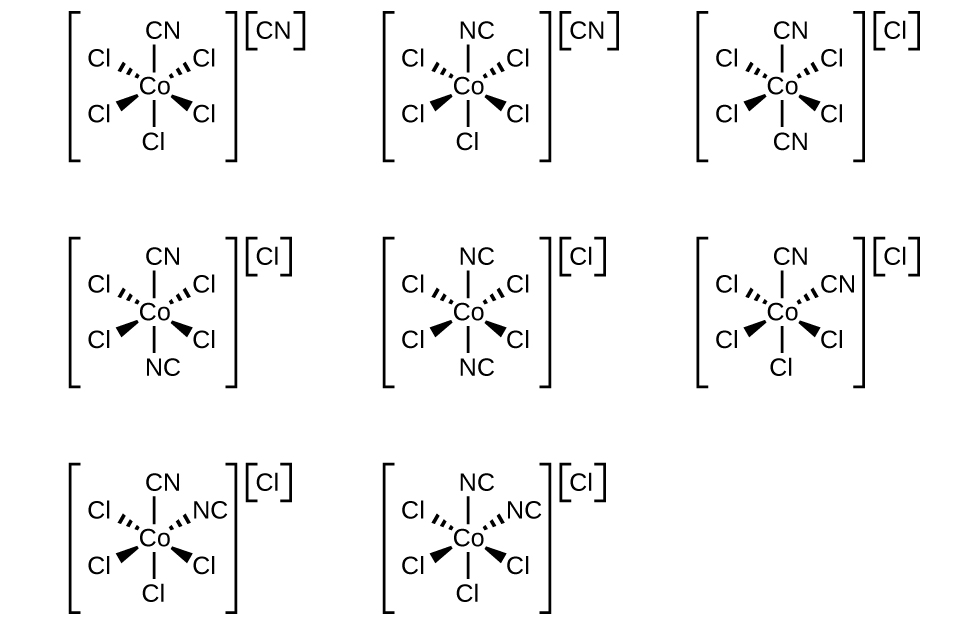
    This figure shows eight structures, each inside brackets in three rows. The first row contains three structures, the second row contains three structures, and the third row contains two structures. These structures are described in increasing order moving left to right and top to bottom in the figure. Each includes a central C o atom with line segments indicating bonds above and below the central atom. Above and to both the left and right, dashed wedges with vertices at the C o atom widening as they move out from the atom indicates single bonds. Similarly, solid wedges below and to both the left and right indicate single bonds. Outside each structure in brackets, to the right, an element or group is identified in brackets as a superscript. In the first structure, the C atom of a C N group is bonded to the C o atom. All 5 remaining bonds are with C l atoms. C N appears in brackets as a superscript outside the structure. In the second structure, the N atom of a C N group is bonded to the C o atom. All 5 remaining bonds are with C l atoms. C N appears in brackets as a superscript outside the structure. In the third structure, the C atom of two C N groups are bonded to the C o atom at the top and bottom of the structure. All 4 remaining bonds are with C l atoms. C l appears in brackets as a superscript outside the structure. In the fourth structure, the C atom of a C N groups is bonded to the C o atom at the top and the N atom of a C N group which is bonded at the bottom of the structure. All 4 remaining bonds are with C l atoms. C l appears in brackets as a superscript outside the structure. In the fifth structure, the N atom of two C N groups are bonded to the C o atom at the top and bottom of the structure. All 4 remaining bonds are with C l atoms. C l appears in brackets as a superscript outside the structure. In the sixth structure, the C atom of two C N groups are bonded to the C o atom at the top and upper right of the structure. All 4 remaining bonds are with C l atoms. C l appears in brackets as a superscript outside the structure. In the seventh structure, the C atom of a C N group is bonded to the C o atom at the top of the structure and the N atom of a C N group is bonded at the upper right of the structure. All 4 remaining bonds are with C l atoms. C l appears in brackets as a superscript outside the structure. In the eighth structure, the N atom of two C N groups are bonded to the C o atom at the top and upper right of the structure. All 4 remaining bonds are with C l atoms. C l appears in brackets as a superscript outside the structure.
    37.
    A diagram is shown with two columns and two rows of squares outlined in yellow. The first column is labeled “[ F e ( N O subscript 2 ) subscript 6 ] superscript 4 negative sign.” The second is labeled, “[ F e F subscript 6 ] superscript 3 negative sign.” In the left column, three linked squares outlined in yellow are shown. Each of the squares contains two half arrows, one pointing up and one pointing down. In a row just above, two empty linked squares are shown. The label, “Low spin, diamagnetic, P less than capital delta subscript oct,” is provided below the column. In the right column, three linked squares outlined in yellow are shown. The square on the left contains two half arrows, one pointing up and one pointing down. The other two squares each contain a single upward pointing half arrow. In a row just above, two linked squares are shown which each contain a single upward pointing half arrow. The label, “High spin, paramagnetic, P greater than capital delta subscript oct,” is provided below the column.
    39.

    [Co(H₂O)₆]Cl₂ með þremur ópöruðum rafeindum.

    41.

    (a) 4; (b) 2; (c) 1; (d) 5; (e) 0

    43.

    (a) [Fe(CN)₆]⁴⁻; (b) [Co(NH₃)₆]³⁺; (c) [Mn(CN)₆]⁴⁻

    45.

    Fléttan hefur engar óparaðar rafeindir. Hún hefur engar rúmhverfur, en spegilmyndin er ekki sköranleg, þannig að hún hefur spegilhverfu.

    47.

    Nei. Au⁺ hefur fullskipað 5d-undirhvolf.

    FYRRI KAFLI

    Kafli 18

    NÆSTI KAFLI

    Kafli 20