Námsgögn
Innskrá
Hleð efnisyfirliti...
Leita í bók...
Efnafræði 2e (IS)
  • Formáli
    • Inngangur
    • 1.1 Efnafræði í samhengi
    • 1.2 Hamir og flokkun efnis
    • 1.3 Eðlis- og efnafræðilegir eiginleikar
    • 1.4 Mælingar
    • 1.5 Óvissa, réttleiki og nákvæmni mælinga
    • 1.6 Stærðfræðileg meðhöndlun mæliniðurstaðna
    • Lykilhugtök
    • Lykiljöfnur
    • Samantekt
    • Æfingar
    • Inngangur
    • 2.1 Fyrstu hugmyndir atómkenningarinnar
    • 2.2 Þróun atómkenningarinnar
    • 2.3 Atómbygging og táknmál
    • 2.4 Efnaformúlur
    • 2.5 Lotukerfið
    • 2.6 Jóna- og sameindasambönd
    • 2.7 Nafnakerfi efna
    • Lykilhugtök
    • Lykiljöfnur
    • Samantekt
    • Æfingar
    • Inngangur
    • 3.1 Formúlumassi og mólhugtakið
    • 3.2 Ákvörðun reynslu- og sameindaformúla
    • 3.3 Mólstyrkur
    • 3.4 Aðrar einingar fyrir styrk lausna
    • Lykilhugtök
    • Lykiljöfnur
    • Samantekt
    • Æfingar
    • Inngangur
    • 4.1 Ritun og stilling efnajafna
    • 4.2 Flokkun efnahvarfa
    • 4.3 Efnamagnfræði efnahvarfa
    • 4.4 Heimtur efnahvarfa
    • 4.5 Megindleg efnagreining
    • Lykilhugtök
    • Lykiljöfnur
    • Samantekt
    • Æfingar
    • Inngangur
    • 5.1 Grunnatriði orku
    • 5.2 Varmamælingar
    • 5.3 Vermi
    • Lykilhugtök
    • Lykiljöfnur
    • Samantekt
    • Æfingar
    • Inngangur
    • 6.1 Rafsegulorka
    • 6.2 Bohr-líkanið
    • 6.3 Þróun skammtafræðinnar
    • 6.4 Rafeindaskipan atóma (Rafeindahýsingar)
    • 6.5 Lotubundnar breytingar á eiginleikum frumefna
    • Lykilhugtök
    • Lykiljöfnur
    • Samantekt
    • Æfingar
    • Inngangur
    • 7.1 Jónatengi
    • 7.2 Samgild tengi
    • 7.3 Lewis-tákn og byggingar
    • 7.4 Formlegar hleðslur og rafeindaómun
    • 7.5 Styrkur jóna- og samgildra tengja
    • 7.6 Sameindabygging og skautun
    • Lykilhugtök
    • Lykiljöfnur
    • Samantekt
    • Æfingar
    • Inngangur
    • 8.1 Gildistengjakenningin
    • 8.2 Blandaðar atómsvigrúm
    • 8.3 Fjöltengi
    • 8.4 Sameindasvigrúmakenningin
    • Lykilhugtök
    • Lykiljöfnur
    • Samantekt
    • Æfingar
    • Inngangur
    • 9.1 Gasþrýstingur
    • 9.2 Tengsl þrýstings, rúmmáls, magns og hitastigs: Kjörgaslögmálið
    • 9.3 Hvarffræði gastegunda, blandna og efnahvarfa
    • 9.4 Útflæði og sveim gastegunda
    • 9.5 Hreyfifræðikenning sameinda
    • 9.6 Frávik frá kjörgashegðun
    • Lykilhugtök
    • Lykiljöfnur
    • Samantekt
    • Æfingar
    • Inngangur
    • 10.1 Millisameindakraftar
    • 10.2 Eiginleikar vökva
    • 10.3 Fasaskipti
    • 10.4 Fasarit
    • 10.5 Fast ástand efnis
    • 10.6 Grindarbyggingar í kristölluðum föstum efnum
    • Lykilhugtök
    • Lykiljöfnur
    • Samantekt
    • Æfingar
    • Inngangur
    • 11.1 Upplausnarferlið
    • 11.2 Raflausnir
    • 11.3 Leysni
    • 11.4 Samræmdir eiginleikar
    • 11.5 Kvoður
    • Lykilhugtök
    • Lykiljöfnur
    • Samantekt
    • Æfingar
    • Inngangur
    • 12.1 Hraði efnahvarfa
    • 12.2 Þættir sem hafa áhrif á hvarfahraða
    • 12.3 Hraðalögmál
    • 12.4 Heildarhraðalögmál
    • 12.5 Árekstrakenningin
    • 12.6 Hvarfgangar
    • 12.7 Hvatning
    • Lykilhugtök
    • Lykiljöfnur
    • Samantekt
    • Æfingar
    • Inngangur
    • 13.1 Efnajafnvægi
    • 13.2 Jafnvægisfastar
    • 13.3 Hliðrun jafnvægis: Lögmál Le Châteliers
    • 13.4 Jafnvægisútreikningar
    • Lykilhugtök
    • Lykiljöfnur
    • Samantekt
    • Æfingar
    • Inngangur
    • 14.1 Brønsted-Lowry sýrur og basar
    • 14.2 pH og pOH
    • 14.3 Hlutfallslegur styrkur sýra og basa
    • 14.4 Vatnsrof salta
    • 14.5 Fjölróteindasýrur
    • 14.6 Stuðpúðar
    • 14.7 Sýru-basa títranir
    • Lykilhugtök
    • Lykiljöfnur
    • Samantekt
    • Æfingar
    • Inngangur
    • 15.1 Útfelling og upplausn
    • 15.2 Lewis sýrur og basar
    • 15.3 Tengd jafnvægi
    • Lykilhugtök
    • Lykiljöfnur
    • Samantekt
    • Æfingar
    • Inngangur
    • 16.1 Sjálfkrafa ferli
    • 16.2 Óreiða
    • 16.3 Annað og þriðja lögmál varmafræðinnar
    • 16.4 Frjáls orka
    • Lykilhugtök
    • Lykiljöfnur
    • Samantekt
    • Æfingar
    • Inngangur
    • 17.1 Upprifjun á oxunar-afoxunarhvörfum
    • 17.2 Rafhlöður
    • 17.3 Rafskauts- og rafhlöðuspennur
    • 17.4 Spenna, frjáls orka og jafnvægi
    • 17.5 Rafhlöður og efnarafalar
    • 17.6 Tæring
    • 17.7 Rafgreining
    • Lykilhugtök
    • Lykiljöfnur
    • Samantekt
    • Æfingar
    • Inngangur
    • 18.1 Lotubundnir eiginleikar
    • 18.2 Tilvist og framleiðsla dæmigerðra málma
    • 18.3 Bygging og almennir eiginleikar hálfmálma
    • 18.4 Bygging og almennir eiginleikar málmleysingja
    • 18.5 Tilvist, framleiðsla og efnasambönd vetnis
    • 18.6 Tilvist, framleiðsla og eiginleikar karbónata
    • 18.7 Tilvist, framleiðsla og eiginleikar niturs
    • 18.8 Tilvist, framleiðsla og eiginleikar fosfórs
    • 18.9 Tilvist, framleiðsla og efnasambönd súrefnis
    • 18.10 Tilvist, framleiðsla og eiginleikar brennisteins
    • 18.11 Tilvist, framleiðsla og eiginleikar halógena
    • 18.12 Tilvist, framleiðsla og eiginleikar eðalgastegunda
    • Lykilhugtök
    • Samantekt
    • Æfingar
    • Inngangur
    • 19.1 Tilvist, framleiðsla og eiginleikar hliðarmálma og efnasambanda þeirra
    • 19.2 Fléttuefnafræði hliðarmálma
    • 19.3 Litrófs- og seguleiginleikar fléttuefnasambanda
    • Lykilhugtök
    • Samantekt
    • Æfingar
    • Inngangur
    • 20.1 Kolvetni
    • 20.2 Alkóhól og eterar
    • 20.3 Aldehýð, ketón, karboxýlsýrur og esterar
    • 20.4 Amín og amíð
    • Lykilhugtök
    • Samantekt
    • Æfingar
    • Inngangur
    • 21.1 Bygging og stöðugleiki kjarna
    • 21.2 Kjarnajöfnur
    • 21.3 Geislavirk hrörnun
    • 21.4 Umbreyting og kjarnorka
    • 21.5 Notkun geislasamsætna
    • 21.6 Líffræðileg áhrif geislunar
    • Lykilhugtök
    • Lykiljöfnur
    • Samantekt
    • Æfingar
  • A | Lotukerfið
  • B | Nauðsynleg stærðfræði
  • C | Einingar og umreiknistuðlar
  • D | Grunnfastar í eðlisfræði
  • E | Eiginleikar vatns
  • F | Samsetning sýra og basa á markaði
  • G | Staðalvarmafræðilegir eiginleikar valinna efna
  • H | Jónunarfastar daufra sýra
  • I | Jónunarfastar daufra basa
  • J | Leysnimargfeldi
  • K | Myndunarfastar fléttujóna
  • L | Staðalrafskautsmætti (hálfrafhlöðumætti)
  • M | Helmingunartímar nokkurra geislasamsætna
    • Kafli 1
    • Kafli 2
    • Kafli 3
    • Kafli 4
    • Kafli 5
    • Kafli 6
    • Kafli 7
    • Kafli 8
    • Kafli 9
    • Kafli 10
    • Kafli 11
    • Kafli 12
    • Kafli 13
    • Kafli 14
    • Kafli 15
    • Kafli 16
    • Kafli 17
    • Kafli 18
    • Kafli 19
    • Kafli 20
    • Kafli 21
  • Atriðaskrá
  • Efnafræði 2e (IS)SvaralykillKafli 15
    Svaralykill

    Kafli 15

    FYRRI KAFLI

    Kafli 14

    NÆSTI KAFLI

    Kafli 16

    1.

    (a) AgI(s) ⇌ Ag⁺(aq) + I⁻(aq); [Ag⁺] = x og [I⁻] = x. (b) CaCO₃(s) ⇌ Ca²⁺(aq) + CO₃²⁻(aq); [Ca²⁺] = x og [CO₃²⁻] = x. (c) Mg(OH)₂(s) ⇌ Mg²⁺(aq) + 2OH⁻(aq); [Mg²⁺] = x og [OH⁻] = 2x. (d) Mg₃(PO₄)₂(s) ⇌ 3Mg²⁺(aq) + 2PO₄³⁻(aq); [Mg²⁺] = 3x og [PO₄³⁻] = 2x. (e) Ca₅(PO₄)₃OH(s) ⇌ 5Ca²⁺(aq) + 3PO₄³⁻(aq) + OH⁻(aq); [Ca²⁺] = 5x, [PO₄³⁻] = 3x og [OH⁻] = x.

    3.

    Engin breyting verður. Fast efni hefur virknina 1 hvort sem lítið eða mikið er af því.

    5.

    Vita þarf leysni silfurbromíðs við nýja hitastigið. Venjulega eykst leysnin og eitthvað af fasta silfurbromíðinu leysist upp.

    7.

    CaF₂, MnCO₃ og ZnS

    9.

    (a) LaF₃(s) ⇌ La³⁺(aq) + 3F⁻(aq); K_sp = [La³⁺][F⁻]³. (b) CaCO₃(s) ⇌ Ca²⁺(aq) + CO₃²⁻(aq); K_sp = [Ca²⁺][CO₃²⁻]. (c) Ag₂SO₄(s) ⇌ 2Ag⁺(aq) + SO₄²⁻(aq); K_sp = [Ag⁺]²[SO₄²⁻]. (d) Pb(OH)₂(s) ⇌ Pb²⁺(aq) + 2OH⁻(aq); K_sp = [Pb²⁺][OH⁻]².

    11.

    (a) 1,77 × 10⁻⁷; (b) 1,6 × 10⁻⁶; (c) 2,2 × 10⁻⁹; (d) 7,91 × 10⁻²²

    13.

    (a) 2 × 10⁻² M; (b) 1,5 × 10⁻³ M; (c) 2,27 × 10⁻⁹ M; (d) 2,2 × 10⁻¹⁰ M

    15.

    (a) 6,4 × 10⁻⁹ M = [Ag⁺], [Cl⁻] = 0,025 M. Athugun: (6,4 × 10⁻⁹ M / 0,025 M) × 100% = 2,6 × 10⁻⁵%, sem er óveruleg breyting. (b) 2,2 × 10⁻⁵ M = [Ca²⁺], [F⁻] = 0,0013 M. Athugun: (2,26 × 10⁻⁵ M / 0,00133 M) × 100% = 1,70%. Þetta gildi er minna en 5% og má því hunsa það. (c) 0,2238 M = [SO₄²⁻]; [Ag⁺] = 7,4 × 10⁻³ M. Athugun: (3,7 × 10⁻³ / 0,2238) × 100% = 1,64 × 10⁻²%; skilyrðið er uppfyllt. (d) [OH⁻] = 2,8 × 10⁻³ M; [Zn²⁺] = 5,7 × 10⁻¹² M. Athugun: (5,7 × 10⁻¹² / 2,8 × 10⁻³) × 100% = 2,0 × 10⁻⁷%; x er minna en 5% af [OH⁻] og er því óverulegt.

    17.

    (a) Ekki má hunsa breytingu á upphafsstyrk samjónarinnar; leysa þarf annars stigs jöfnu. [Tl⁺] = 0,031 M og [Cl⁻] = 0,0056 M. (b) Hunsa má breytingu á upphafsstyrk samjónarinnar. [Ba²⁺] = 2,4 × 10⁻⁴ M og [F⁻] = 0,313 M. (c) Hunsa má breytingu á upphafsstyrk samjónarinnar. [Mg²⁺] = 0,0244 M og [C₂O₄²⁻] = 2,9 × 10⁻⁵ M. (d) Hunsa má breytingu á upphafsstyrk samjónarinnar. [Ca²⁺] = 5,18 × 10⁻⁴ M og [C₂O₄²⁻] = 0,051 M.

    19.

    Styrkbreytingarnar eru meiri en 5% og fara því yfir hámarkið fyrir að hunsa breytinguna.

    21.

    CaSO₄·2H₂O er leysanlegasta kalsíumsaltið, bæði í mól/L og g/L.

    23.

    7,8 × 10⁻³ M = [SO₄²⁻] = [Ca²⁺]. Þar sem þessi styrkur er hærri en 2,60 × 10⁻³ M uppfyllir vatnið ekki staðlana.

    25.

    Massi CaSO₄·2H₂O = 0,72 g

    27.

    (a) [Ag⁺] = [I⁻] = 1,3 × 10⁻⁵ M; (b) [Ag⁺] = 2,88 × 10⁻² M og [SO₄²⁻] = 1,44 × 10⁻² M; (c) [Mn²⁺] = 3,7 × 10⁻⁵ M og [OH⁻] = 7,4 × 10⁻⁵ M; (d) [Sr²⁺] = 4,3 × 10⁻² M og [OH⁻] = 8,6 × 10⁻² M; (e) [Mg²⁺] = 1,3 × 10⁻⁴ M og [OH⁻] = 2,6 × 10⁻⁴ M.

    29.

    (a) 1,45 × 10⁻⁴; (b) 8,2 × 10⁻⁵⁵; (c) 1,35 × 10⁻⁴; (d) 1,18 × 10⁻⁵; (e) 1,08 × 10⁻¹⁰

    31.

    (a) CaCO₃ fellur út. (b) Efnasambandið fellur ekki út. (c) Efnasambandið fellur ekki út. (d) Efnasambandið fellur út.

    33.

    1,42 × 10⁻⁹ M

    35.

    9,2 × 10⁻¹³ M

    37.

    [Ag⁺] = 1,8 × 10⁻³ M

    39.

    6,3 × 10⁻⁴

    41.

    (a) 2,25 L; (b) 7,2 × 10⁻⁷ g

    43.

    100% þess leysist upp

    45.

    (a) Hg₂²⁺ og Cu²⁺: Bætið við SO₄²⁻. (b) SO₄²⁻ og Cl⁻: Bætið við Ba²⁺. (c) Hg²⁺ og Co²⁺: Bætið við S²⁻. (d) Zn²⁺ og Sr²⁺: Bætið við OH⁻ þar til [OH⁻] = 0,050 M. (e) Ba²⁺ og Mg²⁺: Bætið við SO₄²⁻. (f) CO₃²⁻ og OH⁻: Bætið við Ba²⁺.

    47.

    AgI fellur fyrst út.

    49.

    1,5 × 10⁻¹² M

    51.

    3,99 kg

    53.

    (a) 3,1 × 10⁻¹¹; (b) [Cu²⁺] = 2,6 × 10⁻³ og [IO₃⁻] = 5,3 × 10⁻³

    55.

    9,3 × 10⁻⁶ g Pb(OH)₂

    57.

    Mg(OH)₂(s) ⇌ Mg²⁺(aq) + 2OH⁻(aq); K_sp = [Mg²⁺][OH⁻]². Massi Mg(OH)₂ = 1,23 × 10⁻³ g.

    59.

    MnCO₃ fellur fyrst út vegna þess að það hefur minnsta K_sp-gildið af þessum hliðstæðu efnasamböndum og er því minnst leysanlegt. MgCO₃·3H₂O fellur síðast út vegna þess að það hefur stærsta K_sp-gildið og er leysanlegast.

    62.

    Þegar magn fasta efnisins er svo lítið að mettuð lausn myndast ekki.

    64.

    8,2 × 10⁻⁵ M

    66.

    5 × 10²³

    68.
    This table has two main columns and three rows. The first row for the first column does not have a heading and then has the following in the first column: Initial concentration ( M ) and Equilibrium ( M ). The second column has the header, “[ C d ( C N ) subscript 4 to the second power superscript negative sign ] [ C N superscript negative sign ] [ C d to the second power superscript positive sign ].” Under the second column is a subgroup of two rows and three columns. The first column contains the following: 0.250 and 0.250 minus x. The second column contains the following: 0 and 4 x. The third column contains the following: 0 and x.

    [Cd²⁺] = 5,0 × 10⁻⁵ M; [CN⁻] = 2,0 × 10⁻⁴ M

    70.

    [Co³⁺] = 3,0 × 10⁻⁶ M; [NH₃] = 1,8 × 10⁻⁵ M

    72.

    1,3 g

    74.

    0,79 g

    76.

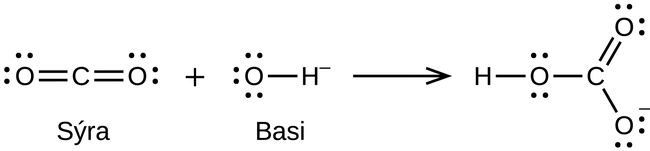
    (a)

    This figure shows a chemical reaction modeled with structural formulas. On the left side is a structure with a central C atom. O atoms, each with two unshared electron pairs, are double bonded to the left and right sides of the C atom. Following a plus sign is another structure in brackets which has an O atom with three unshared electron dot pairs single bonded to an H atom on the right. Outside the brackets is superscript negative sign. Following a right pointing arrow is a structure in brackets that has a central C atom to which 3 O atoms are bonded. Above and slightly to the right, one of the O atoms is connected with a double bond. This O atom has two unshared electron pairs. The second O atom is single bonded below and slightly to the right. This O atom has three unshared electron pairs. The third O atom is bonded to the left of the C atom. This O atom has two unshared electron pairs and an H atom single bonded to its left. Outside the brackets to the right is a superscript negative symbol.

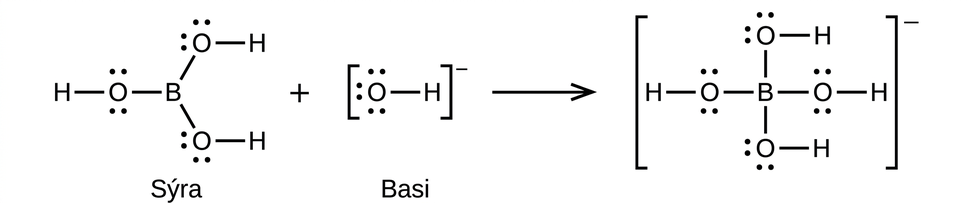
    (b)

    This figure shows a chemical reaction modeled with structural formulas. On the left side is a structure that has a central B atom to which 3 O atoms are bonded. The O atoms above and below slightly right of the B atom each have an H atom single bonded to the right. The third O atom is single bonded to the left side of the B atom. This O atom has an H atom single bonded to its left side. All O atoms in this structure have two unshared electron pairs. Following a plus sign is another structure which has an O atom single bonded to an H atom on its right. The O atom has three unshared electron pairs. The structure appears in brackets with a superscript negative sign. Following a right pointing arrow is a structure in brackets has a central B atom to which 4 O atoms are bonded. The O atoms above, below, and right of the B atom each hav an H atom single bonded to the right. The third O atom is single bonded to the left side of the B atom. This O atom has an H atom single bonded to its left side. All O atoms in this structure have two unshared electron pairs. Outside the brackets to the right is a superscript negative symbol.

    (c)

    This figure illustrates a chemical reaction using structural formulas. On the left, two I atoms, each with 3 unshared electron pairs, are joined with a single bond. Following a plus sign is another structure which has an I atom with four pairs of electron dots and a superscript negative sign. Following a right pointing arrow is a structure in brackets that has three I atoms connected in a line with single bonds. The two end I atoms have three unshared electron dot pairs and the I atom at the center has two unshared electron pairs. Outside the brackets is a superscript negative sign.

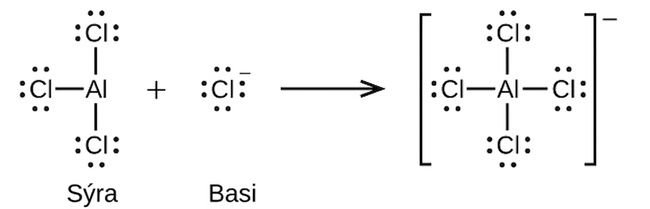
    (d)

    This figure illustrates a chemical reaction using structural formulas. On the left, an A l atom is positioned at the center of a structure and three Cl atoms are single bonded above, left, and below. Each C l atom has three pairs of electron dots. Following a plus sign is another structure which has an F atom is surrounded by four electron dot pairs and a superscript negative symbol. Following a right pointing arrow is a structure in brackets that has a central A l atom to which 4 C l atoms are connected with single bonds above, below, to the left, and to the right. Each C l atom in this structure has three pairs of electron dots. Outside the brackets is a superscript negative symbol.

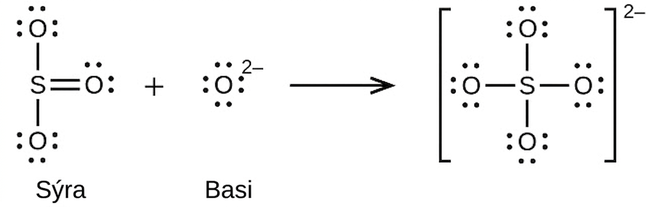
    (e)

    This figure illustrates a chemical reaction using structural formulas. On the left is a structure which has an S atom at the center. O atoms are single bonded above and below. These O atoms have three electron dot pairs each. To the right of the S atom is a double bonded O atom which has two pairs of electron dots. Following a plus sign is an O atom which is surrounded by four electron dot pairs and has a superscript 2 negative. Following a right pointing arrow is a structure in brackets that has a central S atom to which 4 O atoms are connected with single bonds above, below, to the left, and to the right. Each of the O atoms has three pairs of electron dots. Outside the brackets is a superscript 2 negative.
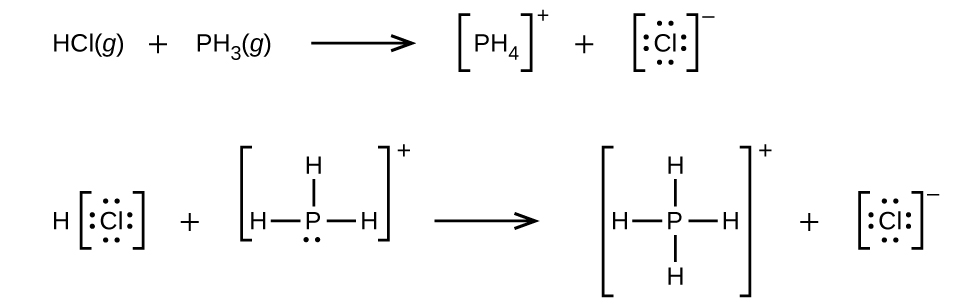
    78.

    (a)

    This figure represents a chemical reaction in two rows. The top row shows the reaction using chemical formulas. The second row uses structural formulas to represent the reaction. The first row contains the equation H C l ( g ) plus P H subscript 3 ( g ) right pointing arrow left bracket P H subscript 4 right bracket superscript plus plus left bracket C l with 4 pairs of electron dots right bracket superscript negative sign. The second row begins on the left with H left bracket C l with four unshared electron pairs right bracket plus a structure in brackets with a central P atom with H atoms single bonded at the left, above, and to the right. A single unshared electron pair is on the central P atom. Outside the brackets to the right is a superscript plus sign. Following a right pointing arrow is a structure in brackets with a central P atom with H atoms single bonded at the left, above, below, and to the right. Outside the brackets is a superscript plus sign. This structure is followed by a plus and a C l atom in brackets with four unshared electron pairs and a superscript negative sign.

    (b) H₃O⁺ + CH₃⁻ ⟶ CH₄ + H₂O

    This figure represents a chemical reaction using structural formulas. A structure is shown in brackets on the left which is composed of a central O atom with one unshared electron pair and three single bonded H atoms to the left, right, and above the atom. Outside the brackets to the right is a superscript plus sign. Following a plus sign, is another structure in brackets composed of a central C atom with one unshared electron pair and three single bonded H atoms to the left, right, and above the atom. Outside the brackets to the right is a superscript negative sign. Following a right pointing arrow is a structure with a central C atom with H atoms single bonded above, below, left and right. Following a plus sign is a structure with a central O atom with two unshared electron pairs and two H atoms connected with single bonds.

    (c) CaO + SO₃ ⟶ CaSO₄

    This figure represents a chemical reaction using structural formulas. On the left, C a superscript 2 plus is just left of bracket O with four unshared electron pairs right bracket superscript 2 negative plus a structure with a central S atom to which two O atoms are single bonded at the left and right, and a single O atom is double bonded above. The two single bonded O atoms each have three unshared electron pairs and the double bonded O atom has two unshared electron pairs. Following a right pointing arrow is C a superscript 2 plus just left of a structure in brackets with a central S atom which has 4 O atoms single bonded at the left, above, below, and to the right. Each of the O atoms has three unshared electron pairs. Outside the brackets to the right is a superscript two negative.

    (d) NH₄⁺ + C₂H₅O⁻ ⟶ C₂H₅OH + NH₃

    This figure represents a chemical reaction using structural formulas. A structure is shown in brackets on the left which is composed of a central N atom with four single bonded H atoms to the left, right, above, and below the atom. Outside the brackets to the right is a superscript plus sign. Following a plus sign, is another structure in brackets composed of a C atom with three single bonded H atoms above, below, and to the left. A second C atom is single bonded to the right. This C atom has H atoms single bonded above and below. To the right of the second C atom, an O atom is single bonded. This O atom has three unshared electron pairs. Outside the brackets to the right is a subperscript negative. Following a right pointing arrow is a structure composed of a C atom with three single bonded H atoms above, below, and to the left. A second C atom is single bonded to the right. This C atom has H atoms single bonded above and below. To the right of the second C atom, an O atom is single bonded. This O atom has two unshared electron pairs and an H atom single bonded to its right.
    80.

    0,0281 g

    82.

    HNO₃(l) + HF(l) ⟶ H₂NO₃⁺ + F⁻; HF(l) + BF₃(g) ⟶ H⁺ + BF₄⁻

    84.

    (a) H₃BO₃ + H₂O ⟶ H₄BO₄⁻ + H⁺. (b) Rafeindaform og sameindalögun eru eins, bæði fjórflötungslaga. (c) Fjórflötungsbyggingin samræmist sp³-svigrúmablöndun.

    86.

    0,014 M

    88.

    7,2 × 10⁻¹⁵ M

    90.

    4,4 × 10⁻²² M

    93.

    [OH⁻] = 4,5 × 10⁻⁶; [Al³⁺] = 2 × 10⁻¹⁶ (mólleysni)

    95.

    K_sp = [Ba²⁺][SO₄²⁻] = [Ba²⁺](0,049) = 1,08 × 10⁻¹⁰; [Ba²⁺] = 2,2 × 10⁻⁹ (mólleysni)

    97.

    [OH⁻] = 7,6 × 10⁻³ M; [Pb²⁺] = 2,1 × 10⁻¹¹ (mólleysni)

    99.

    7,66

    101.

    (a) K_sp = [Mg²⁺][F⁻]² = (1,21 × 10⁻³)(2 × 1,21 × 10⁻³)² = 7,09 × 10⁻⁹. (b) 7,09 × 10⁻⁷ M. (c) Ákvarðið styrk Mg²⁺ og F⁻ sem verður til staðar í lokarúmmálinu. Berið gildi jónafeldisins [Mg²⁺][F⁻]² saman við K_sp. Ef þetta gildi er stærra en K_sp myndast botnfall. 0,1000 L × 3,00 × 10⁻³ M Mg(NO₃)₂ = 0,3000 L × M Mg(NO₃)₂, þannig að M Mg(NO₃)₂ = 1,00 × 10⁻³ M. 0,2000 L × 2,00 × 10⁻³ M NaF = 0,3000 L × M NaF, þannig að M NaF = 1,33 × 10⁻³ M. Jónafeldið er (1,00 × 10⁻³)(1,33 × 10⁻³)² = 1,77 × 10⁻⁹. Þetta gildi er minna en K_sp og því myndast ekki botnfall. (d) MgF₂ er minna leysanlegt við 27 °C en við 18 °C. Þar sem varmi er á myndunarefnahliðinni verkar viðbættur varmi eins og viðbætt myndefni; samkvæmt lögmáli Le Châteliers hliðrast jafnvægið til hvarfefnanna til að vinna gegn röskuninni. Því leysist minna efni upp. Hvarfið er því útvermið.

    103.

    BaF₂, Ca₃(PO₄)₂ og ZnS; hvert þeirra er salt af daufri sýru og H₃O⁺ úr perklórsýru lækkar jafnvægisstyrk anjónarinnar og eykur þar með styrk katjónanna.

    105.

    Áhrif á magn fasta efnisins CaHPO₄, [Ca²⁺] og [OH⁻]: (a) eykst, eykst, minnkar; (b) minnkar, eykst, minnkar; (c) engin áhrif, engin áhrif, engin áhrif; (d) minnkar, eykst, minnkar; (e) eykst, engin áhrif, engin áhrif.

    FYRRI KAFLI

    Kafli 14

    NÆSTI KAFLI

    Kafli 16